The other day I got asked the question on the sizing of crank arms. The individual who asked me the question was a tall female with a 914 mm inseam. I honestly did not know the answer to the question. She went on to say that someone she knew who was tall with a longer inseam switched to a longer crank arm and it increased their power. I got very curious. I always become extremely curious when someone states a singular item for the reason their power increases. My experience, as an athlete and a coach, tells me that a singular item is seldom the result.
I started to read on the topic. What I did know about crank arm length included:
Crank arms influence cadence and the leverage you can exert on the pedals. I think this is obvious.
Longer crank arms are generally used for pushing large gears at low cadence. Long crank arms are used for time trialing and climbing hills. You would have longer crank arms on a mountain bike for better leverage in climbing.
Shorter crank arms are generally used for higer cadenece with smaller gears. Short crank arms are used for track sprints and criteriums.
What I did not know is how complicated the debate on crank arm length is. There are many schools of thought. I concluded that whoever comes up with the formula for proper crank arm length will be a very rich person, and will change the bicycle industry forever.
Blindly changing your crank arm length can lead to a whole lot of problems / issues. It changes positioning on the bike. Saddle height would likely have to change, and possibly the stem. If all factors are not considered, injury and a decrease in power may actually result. What is important to understand is for every increment you lengthen the crank, your knee is double that increment closer to you torso as you start to apply power to the pedals at the top dead center.
Here are some links on the topic. It is interesting reading.
(*Normalized PowerTM (NP), Intesity FactorTM (IF), Training Stress ScoreTM (TSS) are trademark metrics of TrainingPeaks.)
This is a summary of an article by Andrew R. Coggan, Ph.D.
Why is a power meter so variable, or "jumpy" when training outside?
Resistance changes because of elevation and wind
It is very hard to keep power constant or in a zone during a training session outdoors
What data do you need to look?
Normalized Power (NP)
Intensity Factor (IF)
Training Stress Score (TSS)
What does each of these mean and what do they tell you?
Normalized Power (NP) – it is an algorithm. It has two pieces of information incorporated. One has to do with how the body is impacted by intensity during duration of a work effort. The other has to do with how physiological responses tend to follow a curved line rather than being linear. Keeping track of normalized power quantifies the actual intensity of a workout session. It is an estimate of the power the rider could have maintained for the same physiological "cost" if the output power was constant.
“normalized power during a hard ~1 hour long criterium or road race will often be similar to what a rider can average when pedaling continuously during flat 40k time trial - the normalized power from mass start races can therefore often be used to provide an initial estimate of a rider's threshold power” (Andrew R. Coggan, Ph.D.)
Intensity Factor (IF) - ratio of the normalized power to your threshold power. This allows for comparison of workouts, and between riders.
Coggan uses these IF values for workouts:
Less than 0.75 recovery rides
0.75-0.85 endurance-paced training rides
0.85-0.95 tempo rides, aerobic and anaerobic interval workouts (work and rest periods combined), longer (>2.5 h) road races
0.95-1.05 lactate threshold intervals (work period only), shorter (under 2.5 h) road races, circuit, criteriums, longer (eg 40 km) TTs
1.05-1.15 shorter (e.g., 15 km) TTs, track points race
Greater than 1.15 prologue TT, track pursuit, track miss-and-out
Coggan goes on to say that an IF of more than 1.05 for an hour duration race is usually an indication that the threshold power is higher than what is being used in the calculation; it eliminates the need for frequent formal testing.
Training Stress Score (TSS) – combines both the intensity and the duration of each training session. It is a good predictor of glycogen utilized and whether a rest day(s) or easy day is required. It is calculated as follows:
TSS=(sec x NP x IF)/(FTP x 3600) x100
Coggan suggests this as an approximate guide:
Less than 150 - low (recovery generally complete by following day)
150-300 - medium (some residual fatigue may be present the next day, but gone by 2nd day)
300-450 - high (some residual fatigue may be present even after 2 days)
Greater than 450 - very high (residual fatigue lasting several days likely)
If you are training with a power meter and have a mid to higher end bike computer, all these data points are available in the summary of your workout.
A knowledgeable coach will know how to use these data points to train their athletes appropriately.
I was asked a question on indoor training versus outdoor training and why it is common to experience higher perceived efforts working on an indoor trainer. Here is a link to a great explanation:
The other day I was sitting in the hot tub at Talisman and was listening to a conversation about training for a marathon. Before I begin, I want to say that I think it is great that so many people are taking up fitness to complete marathons and ironman distance events. However, I do strongly believe that once an individual has succeeded down this path the next step should be to get better at these events and not just finishing. Time and time again, I hear about people either hammering through training or just putting in way too many kilometers of training. I would like to offer up some suggestions on ways to get stronger and faster without hammering and adding kilometers.
Owen Anderson (who I believe is one of the most knowledgeable individuals on running) suggests increasing leg-muscle power during pre-marathon preparations, rather than by focusing on long, slow runs. I agree with Anderson and this was the key to how I trained and how I train people today.
Here is what Anderson has to offer. If you take 180 steps per minute when you run, and it takes you about 3 hrs and 30 min to run a marathon, then you are taking a total of 37,800 steps for the race. By increasing leg power you will spend less time on the ground with each foot strike as you contract your muscles more explosively. In addition, you will increase your stride length meaning that you cover more ground between steps as your muscle contractions become more forceful.
Let's follow what Anderson says further. He states that if you improve power and this results in .02 seconds less time on the ground per foot strike, then this equates to 756 second improvement in your marathon time (37,800 times .02 seconds). This is an improvement in time from 3:30 to 3:17:24.
Anderson goes on to suggest that if the improved power also gives you an extra half-inch of distance between foot strikes, then you save about 500 meters (37,800 steps X .5 inches). This means that you would shave two minutes off your time. Your time would now be down to 3:15.
Strength is the pre-requisite to becoming more powerful. Hill running and running-specific strengthening movements help to increase your strength. After increasing strength it is important to add plyometric drills such as hops, bounds, one-leg hops in place, step-ups, split squats, etc.
Another important component of training for a marathon is to incorporate marathon pace runs. Instead of plugging through and doing a long 20 to 22 mile run every weekend, try incorporating marathon pace runs every other weekend. Start with 3 miles and gradually increase to 10 miles. For example, run 6 miles at an easy pace, then run 3 miles at marathon pace, follow this up with 6 miles at an easy pace. Eventually, increase the 3 miles to 10 miles over the period of training toward the marathon.
Of course, incorporating various types of intervals during the week is another important element to improving times. However, just by changing things up through the addition of what is suggested above, huge improvements can be made.
Should I be pacing myself or going all out when I’m training?
The answer
Last winter, gold medalist Simon Whitfield led a squad of triathletes from the Canadian national team on a trip to Nike headquarters in Portland, Ore., for a 10-day training camp. Their goal: to elevate their running game by learning from the elite crew of distance runners and highly sought after coaches based there.
One of the key lessons they picked up was the importance of finding the right pace – that, at least in training, going faster isn’t always better. It may sound obvious, but sports psychologists believe that learning to monitor and adjust to feedback during training is a powerful tool for developing expertise – even in apparently simple activities such as running and biking.
The group Mr. Whitfield trained with in Portland included Simon Bairu of Regina, who earlier this month smashed the Canadian record for 10,000 metres by 13 seconds at a race in Palo Alto, Calif., running 27:23.63. Chris Solinsky, another member of the group, broke the U.S. record in the same race, and a third member of the Portland group also dipped below the old U.S. record.
“They’re so precise about their pacing,” Mr. Whitfield says. “We came home with the message that when a tempo run is supposed to be, let’s say, 3:05 [per kilometre] pace, then 3:03 pace is not a success. That’s a fail.”
Such precision may be daunting, but it’s a hallmark of “deliberate practice,” a concept advanced by Florida State University cognitive psychologist Anders Ericsson and popularized in recent books like Malcolm Gladwell’s Outliers: The Story of Success. The best way to master an activity is not simply to repeat it mindlessly over and over again, Dr. Ericsson argues, but to set specific goals and monitor how well you meet them.
The theory is most commonly applied to highly technical activities such as tennis or violin; for simpler activities such as running, “practice” usually involves simply heading out the door and doing it. But in a study of the training practices of elite runners by University of Ottawa researchers Bradley Young and John Salmela, what separated the highest-performing group from their less accomplished peers was how much they incorporated elements such as interval training, tempo runs and time trials, all of which require ongoing attention to pace and other feedback.
Once you become familiar with how different paces feel and how long you’re able to maintain them, knowing your speed can actually enhance performance, according to a study in a forthcoming issue of the British Journal of Sports Medicine. Researchers had cyclists perform a four-kilometre time trial around a track, with no intermediate pacing information provided. When they repeated the trial with pace feedback after each 250-metre lap, the times improved; when the riders were given deliberately incorrect pace feedback, the times got slower.
You don’t need to head to a track to implement these ideas. Many bike paths have kilometres marked, and you can use programs such as Google Earth to measure a route. Alternately, you can simply pick a few landmarks along your route without worrying about the precise distance, and monitor how your time between those landmarks varies from week to week.
The goal isn’t to get faster every time you run; it’s to develop an automatic feel for how fast you’re running, so that when you do check your watch, it just confirms what you already knew.
“I think that it is extremely important for an athlete to understand how they feel during exercise,” says University of Bedfordshire exercise physiologist Lex Mauger, the lead author of the cycling study. “Performance varies from day to day, so a particular pace that was appropriate one day may not be the next.”
After two Olympic medals, you might think Mr. Whitfield had pretty much figured out how to train. But it’s his attention to these details and his desire to keep learning that underlie his continued success – even though he confesses that incorporating the new lessons hasn’t been easy.
“Even our tempo run today turned into one of those where you’re slowly ramping up and up and up,” he laughs. “But in general we’re trying to be more precise about what pace we’re supposed to run.”
Alex Hutchinson blogs about research on exercise at sweatscience.com.
Regardless of the level of runner learning proper running mechanics is important. Learning proper mechanics will improve your performance and help you avoid injuries.
Everyone’s form looks a bit different. Some individuals run low to the ground with little knee lift while others run powerfully, with high knee lift and a strong kick. Even within my own group I have athletes that run with a slight forward lean and others that run very upright. However, there are a number of elements that are common to almost all successful running styles. Good running form is a learned skill.As an athlete progresses to more advanced levels of running, the more important running form becomes.
Proper form involves having the chest out just a few inches with the shoulders back, letting the body fall forward, with the center of gravity being over the feet, and the arms at a right angle.
Foot Plant
For distance runners, the most efficient foot plant is one in which the foot lands directly under the hips or your center of gravity. The ideal landing position is slightly toward the outside edge of your foot, just behind your little toe. Your foot would then naturally roll slightly inward while pushing off over your big toe. The slight inward roll of your foot is called pronation and provides some cushioning during the running stride. A small amount of pronation is normal and desirable, but excessive pronation can also be the cause of injury and stride inefficiencies. Excessive pronation can be caused by weak muscles in your lower leg or stride inefficiencies.
The most common problem I see in foot strike is landing on the heel.When you land on your heel, the leg is straight and extends in front of the body.This combination transfers a lot of impact up though to the knee and hip.Shin splints (pain of the front of your lower legs) is the common running injury that can be caused by heel striking.
A heel first foot plant also means you are over striding. You are reaching out in front of your body with each step you take. When you reach out in front of your body, you will land heel first and essentially be putting on the brakes with each step. You are wasting energy and making your training run harder than it should be.
Toe first landing is more appropriate for sprinters and not distance runners.Toe first landing places too much stress on the calf muscles.
Posture
Some time ago on my blog I wrote about my early days of running, and how I spent a year only working on form.This was important to become more efficient and eventually faster.A straight and erect back with a slight lean is what one needs to strive for.The very slight forward lean provides for a completely balanced posture. Balance is the key word. You should always feel as if your upper body is in balance above your hips.
Try this:
Stand.Lean your body forward and backward.Notice how your position changes your balance. Only when you are standing with a straight upper body do you feel in balance.Now start to walk forward. When you are beginning to move shift your upper body very slightly forward. You are leaning into your movement. In a way when you walk you are actually falling forward and catching yourself with your legs. Running is the same.When you run you need to lean forward to keep your body balanced over your hips.
If you kept your body straight your balance would be shifted to the rear of your body. You would not be able to continue the action of falling forward. You would have to reach out in front of your body and pull your legs back to create forward motion.A backward lean will cause you to over stride and land heavily on your heel, which will also stress your knees, hips and back.
If you lean too far forward you will begin a stumbling, high impact stride. You will also put excessive stress on your knees and back.
Another common form error is sitting too much.This causes your feet to be in front of your body with a very weak push off behind your body.Essentially, you are creating additional contact time with the ground which can lead to Achilles problems.
Running with your hips forward will help your knee lift higher, with less effort.
Stride Length
Over striding is a very common problem I see when someone is trying to get faster.Forcing a long stride length will not improve speed or running efficiency. Over striding results in reaching out in front of the body with the foot and landing heavily on the heel, and causing a braking action.Remember your foot should land directly under your body with every step.
It is still important to still find your maximum stride length but without over striding.The key is not to reach out with your forward foot.Allow the forward momentum of your body to catch up with your forward foot so that no braking action is initiated. Think increasing your stride length by opening up your stride or making bigger circles with your feet and legs.
Stride Mechanics
Your stride should be quick and light and all your effort should be forward.It is important to minimize any up and down motion which leads to wasting energy.In addition, listen to your steps.Your steps should be light and quiet.A noisy step means you are running with too much up and down motion, or are leaning forward too much.
Knee lift is less important in distance running compared to sprinting.A high knee lift requires the use of too much energy to maintain for a long period of time. A proper knee lift should feel like you are driving your knee forward, not up. A forward knee drive will result in a low to the ground and efficient forward running motion.
To initiate your foot plant, slightly pull your lead foot back gently so that it will match the speed of the ground moving under your body. That way you will avoid any braking action and will run very smoothly and efficiently. Immediately after your foot plant concentrate on quickly picking your foot up to continue the cycling motion.
Arms
Keep your arm swing compact and your elbows at about a 90 degree angle.The arms should hang loose and relaxed, close to the body. Avoid any tenseness in the shoulders and the wrists should be loose and floppy.Do not clench your fists. Drive your arms backward.Driving your elbows back when you run will help you run with a quick, light and efficient stride. This is important as a forward arm drive will encourage over striding.
The arm swing provides balance and coordination with the legs.As such, do not drive your arms above your chest or behind the midline of the body.Do not cross your hand in front of your body.
To practice arm drive use a light set of weights and mimic the running motion.Arms drive your stride!
Summary
Essentially, when one become more efficient as a runner, the outcome is three things:
1.Stride length becomes longer
2.Contact time with the ground is reduced
3.Cadence is quicker
By working on form, the above will be the natural outcome.
I have not written in some time so I thought I best get on it. I have had a very busy summer being away every weekend in the mountains running as I prepare for the Trans Rockies Run. As well, my day time life as a Project Manager has been busy with a tough project with high visibility. Those that know me realize that I only take on complex and challenging gigs. My last two projects have been super rewarding, and are well known in the marketplace.
I am happy to be running consistently, and gaining strength that has not been around for the last two years do to injuries and the inability to run. Bike racing has been the focus over the last two years as such. However, since Banff Bike Fest I have been on the bike very little as running has been occupying all my time; trail running has a way of making the legs very sore! I do miss the bike, and I am very excited about cyclo cross starting upon my return from the Trans Rockies Run. I really was sad when I tore two tendons in my calf half way through cylco cross season last year. I will also be competing in cross country running in the fall as Nationals are in Vancouver this year. I would love to be able to obtain a top 10 finish in the Masters (over 35 years of age).
The Trans Rockies run begins on August 21. I began my three week taper toward the race this past Monday. On Sunday, I will do a 20km trail race in Canmore as part of my preparation and taper. I am very excited, nervous, and frankly scared of doing the Trans Rockies Run. I love cross country running, but trail running has been an awakening. It is tough, and draining. The downhills have been hard on the legs, but I feel my quads and toes have adjusted to the impact and jarring. The scenery and beauty of my own back yard of Kananaskis and the Rockies has been very rewarding in my journey. I am very excited to see beauty of Colorado through running from Buena Vista to Beaver Creek.
What is the race all about? The elevation is all above 7,000 feet. A total of 62% of the race is between 7,000 and 10,000 feet and the remaining 38% is between 10,000 and 13,000 feet. In terms of surface, 88% is on trail and 12% on paved roads and pathways. The breakdown of stages are as follows:
In summary, we will cover 119.5 miles, 20,800 feet elevation gain.
The Trans Rockies Run is done with a partner. The rules are pretty simple: you have to do the run starting and finishing together. At all control points, and at the finish of each stage, the team must be within the allowable time limit of two minutes of each other. A penalty of 60 minutes is assessed otherwise.
My teammate for the event was Dr. Sharisse Kyle, but she tore her meniscus. As such, I had to find a new partner. I am happy to say that Heather Johnson will be joining me. Heather is a strong runner, and I am happy that she agreed to participate with me. Heather is getting married on August 6, and it looks like this will be her honeymoon!
.
After about a month of really thinking what it is I wanted to do with biking and running this year, I have come to some conclusions. Every year for the last several, I try something new. Well this year is no exception.
In the fall I bought a mountain bike which I have yet to ride. The first order of business for me is to learn to ride it. Last week I had made the decision to only mountain bike race but as of Sunday I decided to stick with a couple of road races, and a couple of mountain bike races. Am I scared about the mountain bike? Yeah! This is new item one.
Item number two is not totally new as it has the word run in it. However, I have been a road, track and cross country runner, but never a trail runner. I will be running the Trans Rockies 6 day trail race in late August. The race is 120 miles long, goes from Buena Vista to Beaver Creek, through the heart of the White River and San Isable National Forests. My partner in this run is Dr. Sharisse Kyle. I figured it was best to partner up with a Sport Medicine Doctor who can fix me along the way! Seriously though, Sharisse is an amazing athlete. She is very easy going which is opposite to me so we should have a great time. By the way, I just really want to finish. I believe my calf which I tore in September has finally healed completely, and I have managed to run consistently for 5 weeks now!! Sunday was the first time I ran and completely forgot that I had an injured calf.
Item number three is track cycling. I am planning on learning to ride on the track and will throw some of my training on to track. I am really not sure why I did not do this two or three years ago. As in running, training and racing on the track improves top end efforts required in racing. This is an experiment for me to see if, at my age, I can gain more top end speed and power. I do know that as a high performance distance runner, returning to the track and doing track races, resulted in marked improvements in my 5km / 10km times on the road after retiring from the marathon distance.
Three new items for the year! That is a lot but I am out there for fun now, and pretty much do whatever these days!
Here is my race plans for the season:
June 16- 18 - Banff Bike Fest Stage Race
June 25/26 - Mtn Bike / Trail Race - ?
July 9 - Sinister 7 Trail Race
July 30 - Aug 1 - Niklas Bow Cycle bike races
Aug 21-26 - Trans Rockies Trail Race
It is a big season, managing three very different things- mountain bike, road bike, and trail running- but life is about exploring and learning. I put my time in as an elite athlete and now it is about doing different things.
Time after time I hear coaches describing a problem they see in an athlete’s biomechanics with no knowledge of being able to correct it because of a lack of knowledge of running mechanics. As such, they simply tell the athlete to focus or prescribe exercises or drills that only accentuate the problem
To minimize the risk of injury and setbacks in running, it is important to work on your running technique. The things that I stress with my athletes are to avoid the following:
Overstriding. Trying to make a stride too long puts the muscles in an inefficient lengthened position, causing the foot to land in front of the knee and creating a braking effect. Overstriding is caused by trying to run too hard.
Bobbing. Runners waste energy having too much up-and-down movement; the focus should be on forward motion. When an athlete is bobbing it is likely from lifting the knees too high up in front and pushing off the toes, or too short of a stride.
Sitting on the toilet. Also referred to as sitting on the hips, happens when the pelvis tilts forward and the hips push back. This posture reduces the power of the hip extensors, stresses the lower back, and shortens your stride. This is the largest reason for a lot of runners' back and hip problems.
Quad running. Relying too much on the quads and hip flexors rather than using the hamstrings and gluteals to extend the hips reduces the power and length of the stride. Strengthening glutes and hamstrings can improve running technique.
Hip drop (Trendelenburg gait). A Trendelenburg gait occurs when the pelvis shifts too far from side to side. This is a result of weak adductors and abductors. What happens is the hip of the swing leg drops and the hip of the stance leg pops out to the side because the muscles aren't able to hold the pelvis level.
Overpronation. Overpronation results from pushing off on a foot with a collapsed arch. This foot position puts extra stress on the muscles supporting the arch, which in turn pull on their attachments to the inside of the shin bone.
Excessive supination. Oversupination occurs when the foot doesn't roll in enough and remains on the outside edge. This action reduces the foot's ability to absorb the shock of impact and increases the risk of stress fractures, especially along the outside edge of the foot and shin.
Here is a great video that talks about core strength training and why it is so important. Core strength training can help improve running form.
Cycling Development Program The Oval Cycling Development Program is open to kids (ages 11-16) of all abilities who share an interest in learning and developing cycling and athletic skills. Through this program we explore the fundamentals of sport, placing emphasize on continued fun, knowledge, fitness, and technique. The program works towards facilitating athletic growth and development in all cycling disciplines, including road, mountain bike, track, and cyclo cross. The program will also develop the athlete through cross training in other sports such as cross country skiing, speed skating, hiking, and other indoor and outdoor team activities (i.e., soccer, floor hockey, volleyball, etc.) During the summer, the program shifts towards providing experience in local racing of all the disciplines. The Oval Cycling Development Program is a direct link to Oval Cycling Performance Program.
Athletes take part in coached sessions and are required to have their own bike (MTB and/or road). The Olympic Oval National Cycling Centre will provide rollers for use during indoor training sessions. Athletes are also required to bring athletic shoes and clothing for strength and agility practices.
Training schedule
■Tuesday: Guided Coaching Sessions at the Oval from 5 to 7 p.m. ■Thursday: Guided Coaching Sessions at the Oval from 5 to 7 p.m. ■Saturday or Sunday: Guided Coaching Sessions at the Oval from 10am to ~2pm
Example:
Tuesday: bicycle skill development - outdoor rides in the fall and indoor bike skills in the winter (on rollers or trainer)
Thursday: aerobic development on bike as well as various outdoor and indoor cross training activities. This could include soccer, basketball, volleyball, ultimate Frisbee, floor hockey, speed skating and xc-skiing.
Saturday: outdoor aerobic activity such as hiking, cycling, xc-skiing...
Cost
46 week program: October 19, 2010 to September 17, 2011 - $1,580 (two equal payments of $790 due November 1, 2010 and April 1, 2011)
Please Note Extra fees will be required for travel to competitions, velodrome bookings, group outings and cross training activities
Information Session - Tuesday, October 12, 2010 at 6:00-7:00pm in Olympic Oval Lounge
Cycling Performance Program The Oval Cycling Performance Program is open to junior (16+) and older athletes who have experience in bike racing or other competitive athletic experience. Athletes of this program have mastered the fundamentals of cycling, and are beginning to specialize in specific cycling disciplines (road, track, mountain bike, cyclo-cross). The program works towards facilitating athletic growth and development in specific cycling disciplines, preparing athletes for competition in Alberta races.
Athletes take part in coached sessions and are required to have their own road bike, rollers (and/or trainer), and heart rate monitors. Athletes are also required to bring athletic shoes and clothing for strength and agility practices.
Training schedule
Example: Winter Program
■Monday: Weights and agility training 5 to 7 p.m. ■Tuesday: indoor riding sessions at the Oval from 5 to 7 p.m. ■Wednesday: Weights or cross training at the Olympic Oval from 5 to 7 p.m. ■Thursday: indoor riding sessions at the Oval from 5 to 7 p.m. ■Saturday: Weights and group ride ■Sunday: Non-bike aerobic activity
Cost
46 week program: October 1, 2010 to September 1, 2011 - $2,000 for the season (first payment of $1000 due November 1, 2010 and remainder due April 1, 2011)
Please Note Extra fees will be required for travel to competitions, velodrome bookings, group outings and cross training activities
Information Session - Wednesday, September 29, 2010 at 5pm for athletes and 7pm for parents in Olympic Oval Lounge
Dinos Track and Field-Youth Programs 2010-11
ELEMENTARY INTRO TO TRACK AND FIELD - Ages 7-11 years With the emphasis being on fun and fundamentals, this Track and Field Program introduces basic athletic skills of running, jumping and throwing. Participants will be exposed to a variety of experiences that will enhance their athleticism and provide a solid basic development for future specialization. Programs are specifically developed around elementary-school-aged children. There will be some competition opportunities offered as part of the program.
FALL Sep 18–Nov 27 WINTER Jan 15 -Mar 26 SPRING Apr 16 -Jun 25 Sat 11:00am-12:00pm Cost: $125 per Fall/Winter/Spring Session
JUNIOR HIGH INTRO TO TRACK AND FIELD - Ages 11-14 yrs With the emphasis being on fun and fundamentals, this Track and Field Program introduces basic athletic skills of running, jumping and throwing. Participants will be exposed to a variety of experiences that will enhance their athleticism and provide a solid basic development for future specialization in any sport. Programs are specifically developed around junior-high-aged children, with a hope for continued participation in the sport of Track and Field. There will be some competition opportunities offered as part of the program.
FALL Sep 18–Nov 27 WINTER Jan 15 -Mar 26 SPRING Apr 16 -Jun 25 Sat 9:15am–10:45am Cost: $175 per Fall/Winter/Spring Session
INTERMEDIATE TRACK AND FIELD - Ages 12-15 years This program is organized as an extension of the Junior High Introduction to Track and Field Program and competition opportunities will be encouraged. The emphasis will continue to be on fun and fundamentals. The Track and Field Program will reinforce basic athletic skills of running, jumping and throwing. Basic technical models will be refined to enhance success in track and field competition. Programs are specifically developed around junior-high-aged children, with a hope for continued participation in the sport of Track and Field.
FALL Sep 21–Dec 2 WINTER Jan 15 -Mar 26 SPRING Apr 19 -Jun 23 Tue & Thu 6:30pm-8:00pm Cost: $225 per Fall/Winter/Spring Session
Registration: Campus Recreation, University of Calgary Registration: 220-7749
After five years of coaching, two years of mentoring the coaching staff, two years of developing all the athlete periodization including designing and implementing individual race distance discipline programs and individual yearly training plans (run, bike, swim and strength), three years of clinics/camps, two years of progressively implementing youth programs, and two years of aggressively promoting, I have parted ways with the Kronos Triathlon Club. I am moving on to continue to develop my own coaching practise. Over the last two years my own coaching practise has suffered as I have been juggling my duties for Kronos Triathlon Club and my career as a Program / Project Manager doing large scale ERP implementations.
A week ago, I made a decision that I wanted to be closer to the athletes I coached. I have missed working one on one with athletes. I have missed the connection that develops when working closely with developing athletes, athletes who simply just aspire to be better, and the teens who are the future of sport. My arrangement with the Kronos Triathlon Club was no longer serving my own goals and aspirations. Simply being the "back office" brain while someone else delivered my work was no longer an arrangement I wanted to continue and felt it was bordering on being ethically wrong. I made a proposal to the club to take over as full-time coach / administrator of the club. It was rejected with the message given to me that I did not align with the future goals and long term strategy of the club. Obviously, the Board has no idea how I contributed. I feel cheated as I have been the person who has been looking forward and has put in place programs to attract both youth and adults to the club. I have been the person who has been looking forward and not in the moment. Anyone who knows me clearly recognizes that I am an implementer; my ideas have already gone through my internal filtering system. As such, I walked away from the club as the message given to me was far from the truth and hurt me immensely.
I am excited about building my coaching practise from the ground up again. I have spent the last couple of weeks building some exciting potential partnerships and am looking forward to the next two years as this all transpires.
In the meantime if you are wanting to join a run group..... read below.
If you are looking for more go to my other blog at:
http://www.coachingtheyaworskiway.blogspot.com/
Stay tuned for a new website which combines my personal blog with my coaching blog. Some exciting features will include newsletter subscriptions that will provide you with training tips and tools, courses being offered and information on training venues and packages both locally and in Belgium, Canada and United States. Over the years, as an high performance athlete and coach, I have worked with some of the best coaches. I will now be leveraging these connections to create some exciting stuff.
About my Run Group
Need someone to train with? Looking to get faster? Looking to improve your form?
Then join up with my group for some training on Thursday nights.
• We meet Thursday nights for interval and form work
• Cost is $150 per session (16-week sessions): Sept. to Dec.; Jan – April, May – Aug. for the once a week coached session
• Come November we move indoors to the Oval and you need to pay your own entrance fee
• If you are looking for an individualized program, I can help with that as well. For those signing up for the Thursday intervals, the cost for an individual run program is $50 per month. Programs for Triathlon are also available and if you join my run group, the cost is $100 per month for an individualized triathlon program.
Contact me at yaworski@telusplanet.net to register now.
This is not a learn to run program and individuals must be able to run 45 minutes comfortably. The sessions will involve tempo, interval and speed work. A strong emphasis will be on proper running mechanics.
Upon leaving Germany on Thursday morning, I headed off to Geneva for two days. My ride to the start of the race would pick me up on Saturday afternoon to transfer me to the start location of the Tour.
Geneva is an interesting place. In my opinion, really not a desirable place to visit. It is more restaurants and cafes than any place I have ever been to. The variety of food is amazing as every culture imaginable lives in Geneva. I was very disappointed with the restoration activities of Geneva. However, in my head I am comparing it to Vienna which is absolutely an amazing city. During my ventures around Geneva I did find a couple of very nice areas. One behind the train station and another in the massive park on Lake Geneva. These two locations offer a break from the masses of people on the streets. One afternoon I enjoyed sitting at a cafe reading and talking to some people in a small cafe behind the train station. It was very nice and was in the older area of Geneva.
Interesting that Geneva is considered a very conservative city. I tried to buy a bottle of wine after 9 pm one night and was told that one can not buy alcohol from a retailer after 9 pm in Geneva. You could only do this under the table or go to a bar or restaurant and order it. A local told me where I could buy wine after 9 pm under the table for a few extra bucks. I promptly went to a store and obtained my wine. What is interesting about this is that the streets of Geneva for about a 3 to 5 block radius are lined with prostitutes 24/7. So you can get a hooker any time of day but not alcohol.
I did not take many pictures in Geneva as there really was not much to take a picture of. I thought this building was cool though.
All the major cities in Switzerland have some landmark, and in Geneva it is the water jet. Silly really!
I took this picture in a department store for my friend Shari. She collects pigs and I could not resist taking it.
Alpes Open Tour - August 15 to 20, 2010
I have never cycled in the Alpes so stumbling upon this event was immediate curiosity for me followed by the desire to commit to going. I have many friends who go to France every summer to cycle but I have never even been to France before. I have watched the Tour de France on TV for about 10 years now. I got into watching it upon buying a Lemond bike and later reading about a guy named Lance Armstrong. Now it is no secret that I am a huge Lance fan and even own one of two yellow jerseys of Lance's which reside in Canada. Going to the Alpes to cycle was something I have wanted to do for several years. Finally, it was going to be a reality. For me, this will be the beginning of a yearly trek. I will likely spend two to three weeks every year cycling in France/Spain/Italy from this point forward. It is absolutely incredible cycling and scenery!
Day 1- Thonon-les-Bains to Chatel
Our first day was very wet and cold. We cycled around 90km. It rained very hard for the first part of this ride and luckily for us this stage was relatively flat compared to what we would tackle on the remaining days. Thonon-les Bains is at 540m and we started with a climb to Col du Cou which is at 1115m. After we would descend down to 800m and climb back up to Chatel which is at 1180m. The descends were very cold because of the cool weather and rain. Here are some pictures of the start of the event.
There were less 10 ten women doing this tour amongst the 80 or so riders. I was very surprised by this. So when I say I was the first woman on this stage, it is not all that amazing. Each day I would place within the top 25% of the entire field though which ended up being a goal of mine.
The field included nine professional riders. Teams Sky, Bbox and Cofidis were represented. Amongst the riders were three riders which I will point out as I spoke with them often. These guys are very nice and it was totally cool being able to ride in the same event as them.
Syvian Calzati, Team Sky
David Moncoutie, Team Cofidis
Davide Vigano, Team Sky-- pictured here with his partner. Yes there is a story to come about Davide and his partner!
Here is me at the finish in Chatel.
Day 2 - Chatel to Beaufort
Day two was a brutal day. It rained so hard that most people's computers stopped working. My computer failed and would only have cadence for the remainder of the trip. I think this was a good thing as I do not think I want to know how fast I descended some climbs. Basically, you could see nothing on this day. In total there were three climbs in this stage of 145 km. They included: Col du Corbier 1235m, Col des Gets 1170m, Col des Saisies 1660m. Sadly, this would be the stage, in which on one of the descends, a huge crash would occur right before me. I almost went down! It was on a hairpin descend and to avoid the crash I went into oncoming traffic and narrowly missed hitting a car head-on and skidded my body alongside the mountain on the wrong side of the road. My heart rate soared and at 100km of this ride I called it a day. After standing in the rain for about 10 minutes while everything got all sorted out, I was shaking uncontrollably and had a major descend yet to conquer. So off I went into one of the the support vehicles.
In the support vehicle were two people, one of the organizers and Team Sky rider Davide Vigano. Davide took very good care of me. He opted not to start this stage due to the cold and rain. He immediately put his arm around me to warm me up and started to ensure I consumed sugars to get warm. He took my wet socks and shoes off and gave me his dry socks and shoes and he stripped my jacket, jersey, arms warmers and leg warmers off of me. He gave me his jackets to keep warm. He was absolutely great. Davide then gifted me everything he covered me with to keep warm except for his shoes. At one of the feed stations he even fetched me coffee and more food. I have met many professional and elite athletes in my time and I always admire those that stay humble. Vigano and the two other professionals I have mentioned are very much great ambassadors to their sport.
At the feed station I switched vehicles in order to get to my hotel more quickly. In the vehicle I would end up in I met Vigano's partner and the start and finish line announcer. It was cool being in the vehicle with them. They were very kind and throughout the trip I would get to know them better along with some of the organizers.
Here is a picture of Davide and I.
Here is a picture of a jacket I got from Davide as well. I will wear it with great pride.
Here are some pictures of the places we stayed during the first two days.
Day 3 - Beaufort to Courchevel Day three was absolutely beautiful. The sun was out and our ride of 120km would be the hardest day we would encounter. We began with a climb of 25km with grades averaging 8.5% to an altitude of 1970m starting from 750m. We would then descend to 820m to only climb again to 1300m over 12km and then descend again to 600m to again climb to 1200m over 30km. The last climb would continue from 1200m up to 1850m over 10km. The grades at points were 9.5% to 10%. Courchevel is absolutely beautiful. The little towns we cycled through were very quaint. This is a great area in terms of accessibility to great climbs and an area I definitely would return to in the future.
On both days three and four, 4 female professional riders would join us. As well, two female riders who were partners of Cofidis riders would split the stage. I am happy to say I placed second to the female riders who split the stage. Now granted all the professional riders, both male and female, did not ride hard. But it is cool to be finishing with or ahead of them.
Day 4 - Couchevel to La Toussuire
Day four would start with a descend from Courchevel to 433m over 30km. We would climb from here to 2000m on the famous Col de Madeleine. Our climb would be 28km long. The Col de Madeleine is not a hard climb but it is a long climb. Grades averaged around 7.5%. It was easy to maintain a good solid cadence going up and was an enjoyable climb on a beautiful sunny day. Our climb would lead us to a descend of 30 km down to 525m. This would be followed by a very hard climb up La Toussuire to 1700m over 20km. We would ride about 110km on this day. The legs were very tired and I wondered how day 5 would pan out with three big climbs. Somehow, however, the body seems to recover and cope. Mine did just that. Day four was one of my favourite rides. The scenery was amazing. Both the climbing and descending were wicked.
Here are some pictures of day 4.
Day 5 - La Toussuire to L'Alpe D'Huez
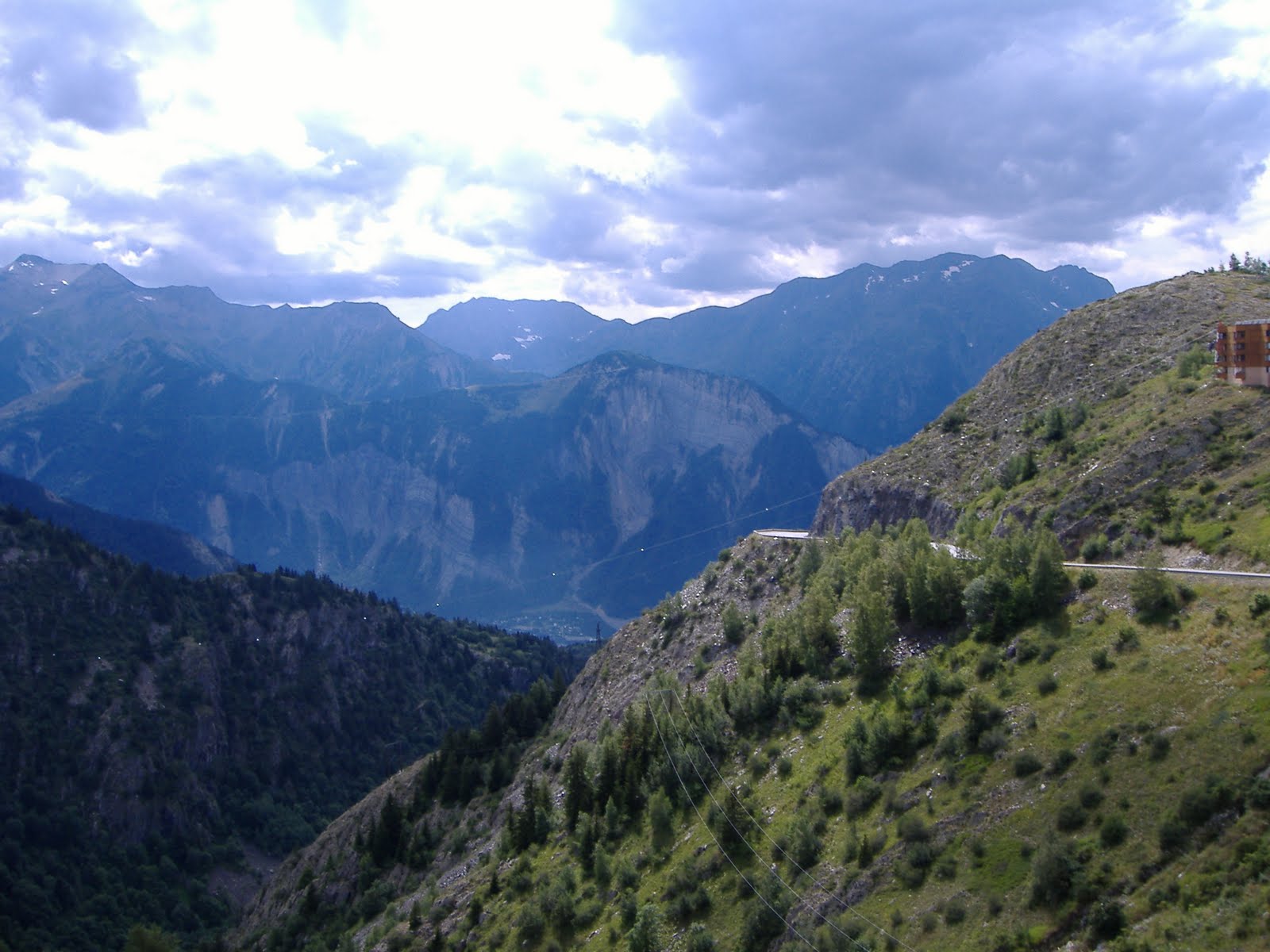
Day five was an epic day and included the time trial up the famous Alpe d'Huez. So what makes Alpe d'Huez so famous? It's one of oldest ski resorts in France, but it's probably more famous now as a finishing climb in mountain stages during 23 of the last 31 Tour de France events. The road up to Alpe d'Huez makes a great climbing stadium because it's wide and has the infrastructure at the base and top to handle over a million people as it did during the 2004 time trial. Many great climbs in France are too narrow and remote for Tour consideration. There are many beautiful, quiet roads in France with views as impressive as those found along Alpe d'Huez.
Alpe d'Huez has been a stage finish almost every year since 1976, although absent from the route in both 2009 and 2010, the first time since then that it has missed two consecutive years.
Before starting the time trial up Alpe d'Huez we would descend down La Toussuire to 1150m over 22km. We would then climb up Col du Mollard at 1631m and continue up to 2067m and the famed Col de la Croix de Fer. This is a very hard climb consisting of very steep grades over 27km. However, we a rewarded with one of the most beautiful descends of the tour. Our descend would take us down to 715m and the starting point of the time trial up Alpe d'Huez. We rode 90km before starting the time trial!
The climb up Alpe d'Huez is 13.8km with an average gradient of 8.1% (1130 m) with 21switchbacks marked with signs honoring each of the Tour de France/Alpe d'Huez stage winners. Since the Tour has now used Alpe d'Huez more than 21 times, the lower signs have been doubled up. The first bend has a double panel honoring both Fausto Coppi and Lance Armstrong; Fausto was the first Tour winner of Alpe d'Huez in 1952 and Lance was the 22nd winner in the year 2001. Totally cool!
Check out this video of Lance's greatest victories:
With the exception of several scenic switchbacks on the climb, the scenery around Alpe d'Huez is best viewed while descending rather than looking over your shoulder. In fact, the scenery, the width and condition of the road make it one of the better descents you'll ever come across. There are so many recreational cyclists climbing Alpe d'Huez each summer that commercial photographers make a business sitting on little canvas stools clicking away all day long. On the day we climbed two photographers snapped pictures and kindly ran behind to shove their cards in your jersey pocket.
Here is a picture I grabbed off the internet highlighting the 21 mythical corners.
Here is a picture of one of the signs you see on the corners.
Here are pictures of the hairpin corners and a view looking down.
And lastly, here is a picture of me on Alpe d'Huez.
Day 6 - Alpe d'Huez to Val Cenis
Day six greeted us with heavy rain. People were very tired and less than eager to experience what we had experienced on day 2. The organizers had already told us the previous night that the descend down the other side of Alpe d'Huez before the climb up Col du Galibier would be very technical, dangerous and have poor visibility. Our group of 9 riders voted not to proceed to do this stage. The fog and rain was considered too much of a risk. The pros rode for 14km and called it a day. They were not willing to take unnecessary risks. I have mixed feelings about the decision. I would have opted to start later in the day but one of our riders had a flight that night so timing was an issue. If I did not have a group to go along with, I would have started the ride later when things cleared up. I really wanted to climb Col du Galibier. As well, my friend Rob had told me that I should climb Col du Galibier from both sides as it is one of the most amazing rides. I guess next time!
Hope you enjoyed my stories! Thanks for reading! Here are more pictures of the Pros:
Pros and ex-pros participate in the Alpes Open Tour (among others, Sylvain Calzatti; Davide Vigano, David Moncoutie, Nicolas Portal, Frederic Turpin, Bernard Thevenet, Thierry Hupond, etc...)
Landed back in town very late Saturday night after a great experience of cycling through the French Alps. It was great to cycle the same roads as the Tour de France riders have traversed over the years. The scenery, roads, and climbs were amazing. I was happy to have set my bike up with a compact crank and a 11/28 as it was perfect. Before heading to the Tour de Alps 6 day stage race, I cycled with Steve and Jason in Germany and Luxembourg. The area of Germany, near Trier, is very scenic. Here is a picture of Jason and Steve at dinner in a small restaurant near where we were staying.
Steve's brother lives on a hill, so before every ride start we would descend down and after every ride we would climb up to the house. On one of the days we stopped at a book store that a German man operated out of an old bunker. His English was very good and he told us stories about how Hilter's troops occupied these same bunkers, during the time when he was trying to conquer Luxembourg. There is only a river that separates the Germany and Luxembourg border.
Luxembourg is amazing. If you ever get a chance to cycle in Luxembourg, go for it. It is a clean and wealthy country, and of course is the home of Andy Schleck.
One of our rides was to the Vianden Castle which was an absolutely beautiful ride. This 145 km ride was amazing and included lots of climbs and rolling terrain. We had great weather and very little traffic to contend with. In the picture above is the town that we had lunch in. I love the bakeries and cafes in Germany and Luxembourg. This is typical road signage of directions to various towns.
Here are some pictures of the Vianden Castle. It is a really big climb to the castle. You can also cycle a further 5km up which I did because I lost sight of where Jason and Steve had gone. The extra climb allowed me to snap these pictures.
One of the coolest things in Germany is how you indicate the time of when you will be returning once you have parked your vehicle. I thought this was totally cool.
We were driving back from Trier one day and took an alternate road. It was crazy. Here is a picture of how narrow the road was - it is for traffice going both directions!
On one of the days we cycled into France to see another castle. It was a shorter ride as we were really bagged from the previous day of cycling. I am certain the keg of beer we drank while sitting outside on the deck of Steve's brothers place did not help our hydration and re=fueling efforts! However, we did have a good time!
Here is a picture of Jason on a tandem bike we saw perched on a fence.
Here are some pictures of the castle in France.
Stay tuned for pictures and write-up on the Tour de Alps 6 day stage race.